
When should a care plan be reviewed?
In England, a council care and support plan is usually reviewed within the first few months of support starting and then once a year, according to the NHS. You don't have to wait for that date: if you're unhappy with the care at any time, you can call adult social services at the local council and ask for a review. A family's own care plan has no set timetable, so look at it every few months and straight after any fall, illness or hospital stay.
Why is this harder than it sounds?
The yearly review is easy to treat as the only one. In practice a year is a long time in someone's care: a parent gets slower on the stairs, a paid carer's visits drift later, the person doing most of the caring gets worn down. None of that waits for the anniversary of the plan, and nobody at the council knows about it unless someone says so. Knowing that you can ask at any time, and what to say when you do, is what keeps a plan matched to real life.
The usual review timetable
For a council care and support plan in England, the NHS describes it like this:
- First review: usually within the first few months of support starting.
- After that: usually once every year.
- In between: at any time, if you're unhappy with the care and ask for one.
- Money is checked separately: the council must regularly reassess your finances, usually once a year.
What a review looks at
The NHS says reviews check what's working, what isn't working, and whether the plan is still the best support for the person. That covers the support itself, how and when it happens, any equipment, and, for a carer's plan, whether the breaks and help set out for the carer are really happening.
Changes worth asking for an early review over
You don't need a special reason beyond being unhappy with the care. These are the situations families most often ring about:
- Visits from paid carers are regularly late, cut short or missed.
- A fall, an illness or a stay in hospital.
- Everyday tasks have got harder: washing, dressing, cooking, getting out.
- Equipment in the plan isn't working for them, or never arrived.
- The person's own wishes have changed.
- The main carer can't keep up any more, or their own health or work has changed.
- Someone has moved in or out, or a relative who helped has moved away.
How to ask for a review
Call adult social services at the local council and say you'd like a review of the care and support plan. Give the person's name, say what has changed, and have two or three dated examples ready. Ask when the review will happen and who will be in touch.
If you're not happy with how an assessment or plan was done, the NHS says you have a right to complain: first to the council, through the complaints procedure on its website, and then to the Local Government and Social Care Ombudsman if you're unhappy with how the council handles it.
How often to review a family care plan
A plan the family wrote for itself has no rule. Every few months works for most families, plus a quick look whenever something changes. Ask three things with the person it's about: what's working, what isn't, and what do we want to change. Then update the names and times, so the plan still says who does what.
What should you do?
Find the date of the last review
It's usually on the plan itself. If support started months ago and nobody has been in touch, ask the council when the first review is due.
Keep a short log
A line a day or a line a week: what happened, what was missed, what got harder. Dates turn a general worry into something a reviewer can act on.
Ask the person what they think
The plan is theirs. What they want to keep, stop or change should lead the conversation.
Ring adult social services if it can't wait
Say you're unhappy with the care, or that needs have changed, and ask for a review now.
Take someone with you
A relative to take notes, or an advocate if explaining things is hard. Advocates are often free.
Get the updated plan in writing
Ask what changes, from when, and when the next review will be.
What tends not to work
Waiting for the yearly review when something has clearly changed.
Saying "it's all fine" on the day because the last week happened to be a good one.
Assuming the council knows about missed visits. Often it only finds out when you say so.
Reviewing the plan without the person it's about.
Common questions
How often should a care plan be reviewed?
For a council care and support plan in England, the NHS says usually within the first few months of support starting and then once every year. A family's own plan is worth reviewing every few months and after any big change.
Can I ask for a care plan review at any time?
Yes. The NHS says that if at any time you're unhappy with your care, you can call adult social services at your local council and ask for a review.
Who reviews a care and support plan?
The local council's adult social services, which wrote the plan, with the person it's for. Family, a friend or an advocate can be there too.
What about a care plan from a care home, hospital or nurse?
Those are the provider's or clinical team's own plans and they set their own review dates. Ask them how often they review it and how you can ask for one sooner.
Where Nura fits
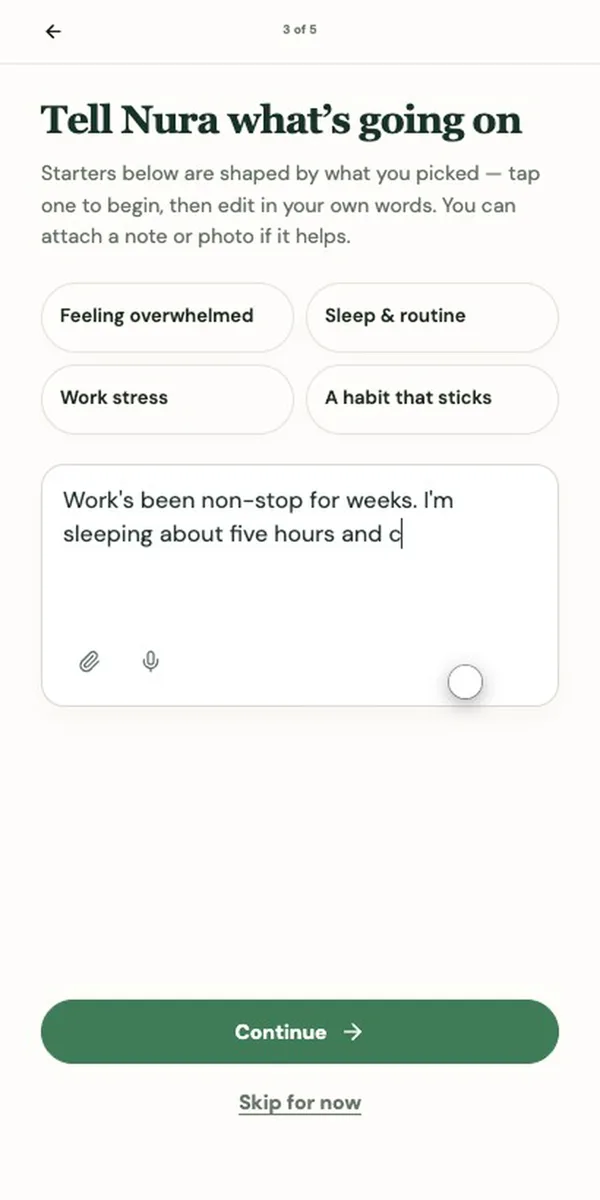
Nura helps with the months between reviews. You keep a Care plan in your own words, and Nura checks in with you about how things are going; you can tell it what the council plan says, or attach a photo of it, and it checks in on whether the support is happening. If the plan is about someone else and they agree on a link you send, Nura gives them a short call in their daytime and tells you how it went. By the time a review comes round, or you decide to ask for one early, you have a record to bring. Nura's Care plans are your own plans; they aren't a council care and support plan and don't replace one.
Sources
General information, not medical advice. Nura does not diagnose, prescribe or replace your clinician. In an emergency call 999 (UK) or 911 (US); in the UK, NHS 111 can help if you need medical help but it isn't an emergency.