
What should a care plan include?
A council care and support plan in England sets out the type of support you need, how it will be given, and how much the council will spend. The NHS lists eight things it includes: what's important to you, what you can do yourself, the equipment or care you need, what your friends and family think, who to contact with questions, your personal budget and direct payments, the care you can get from the council, and how and when care will happen. A family's own plan covers the same ground, plus who does what.
Why is this harder than it sounds?
Most people only see a care plan once it has been written, and it's hard to tell what's missing from a document you've never seen before. A plan can look complete and still leave out the things that decide whether a week works: who to ring when a visit is missed, what the person can and wants to do for themselves, when anyone will check it again. A checklist lets you read a plan properly, or write one that someone else can pick up and use.
What a council care and support plan includes
According to the NHS, care and support plans include:
- What's important to you.
- What you can do yourself.
- What equipment or care you need.
- What your friends and family think.
- Who to contact if you have questions about your care.
- Your personal budget and direct payments: the weekly amount the council will spend on your care.
- What care you can get from your local council.
- How and when care will happen.
What a carer's plan adds
If you're a carer and the plan follows a carer's assessment, the NHS says it will also include:
- Respite care options, so you can take a break.
- Details of local support groups.
- Training, such as how to lift safely.
What to put in a family care plan
A family's own plan isn't an official document, so it can be as short as a page. These headings cover what people stepping in need to know:
- About them: what matters to them, the routines they like, what they don't want.
- What they do for themselves, so help doesn't take it away.
- Help needed through the week: meals, shopping, reminders, washing, getting out, company.
- Who does each thing, and when.
- Contacts: GP practice, pharmacy, care agency, a neighbour with a key, council social services.
- What to do if something goes wrong: who to call first, where the key is, alarm details.
- The date you'll look at it again.
What does a care plan look like?
There's no single form. A council plan is a written document, and the NHS says you should get a copy within a few weeks of the assessment. A family plan often works best as a short table with four columns: the need, what helps, who does it, and when. If a line has no name or no time next to it, that's the gap to sort out.
What should you do?
Get a copy of the plan
If the council has written one and you haven't seen it, ask adult social services for a copy.
Tick it off against the list
Go through the eight items above. Note anything that's missing or vague, such as care with no days or times.
Check it against a real week
Does what the plan says should happen actually happen, at the times it says?
Ask for what's missing
Call adult social services and ask for the gaps to be filled in, or for a review if the plan no longer fits.
Write the family plan for everything else
The lifts, the shopping, the phone calls: put a name and a time against each.
What tends not to work
Assuming a plan is complete because it's long.
Leaving out what the person can still do for themselves.
A plan with no contact name and no review date.
Treating a family plan as a replacement for a needs assessment when more help is needed.
Common questions
What are the main parts of a care plan?
What matters to the person, what they can do themselves, the care or equipment they need, how and when it happens, who to contact, and, for a council plan, the personal budget. A family plan adds who does what.
Does a care plan include the cost?
A council care and support plan does. The NHS says it covers how much money the council will spend on your care and whether you'd be expected to contribute towards the cost.
Do I get a copy of the care plan?
Yes. The NHS says the support you need is written up as a care and support plan and you should get a copy within a few weeks.
Is this the same as a nursing care plan?
No. A nursing or clinical care plan is written by healthcare staff in their own format. This guide is about council care and support plans and families' own plans.
Where Nura fits
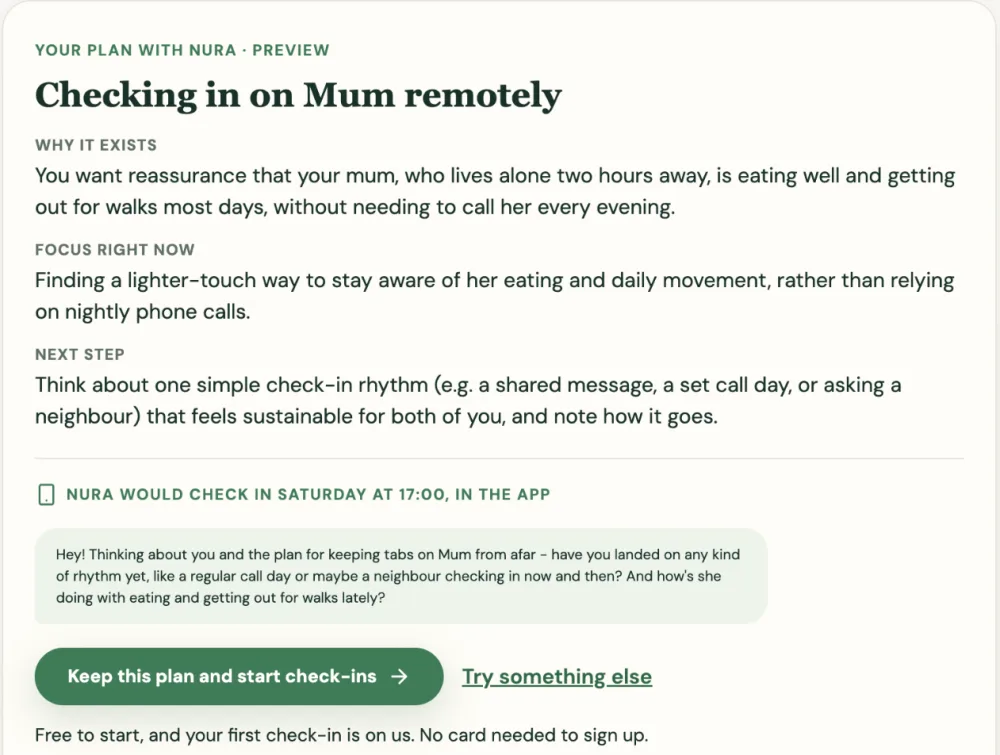
Nura's Care plans are a simple way to keep a family plan in one place. You describe the situation in your own words and Nura drafts a plan with next steps and check-ins, which you can change as things move on. You can invite siblings or a friend to see the same plan (never your private conversation with Nura), and if the plan is about someone else and they agree, Nura can give them a short call in their daytime and tell you how it went. It isn't a council care and support plan or a clinical care plan, and it doesn't replace either.
Sources
General information, not medical advice. Nura does not diagnose, prescribe or replace your clinician. In an emergency call 999 (UK) or 911 (US); in the UK, NHS 111 can help if you need medical help but it isn't an emergency.