
Who is eligible for a care plan?
In England, a council care and support plan follows an assessment, and the NHS says anyone can ask for one. A needs assessment is free and open to anyone who needs help to cope day to day. A carer's assessment is free for anyone over 18 who looks after someone. If the council decides you qualify for support, it writes that support up as a care and support plan. Savings don't stop you being assessed; a separate means test works out who pays.
Why is this harder than it sounds?
People rule themselves out before they ask. They assume you have to be a certain age, have a diagnosis, live alone or have no savings. None of those is the test. The assessment looks at how you're managing everyday life, or, for carers, what caring is doing to yours. The other reason it's confusing is that asking is open to everyone, but getting council support depends on what the assessment finds, and paying for it depends on a third thing, the financial assessment.
Two routes to a care and support plan
The NHS describes two types of assessment, and either can lead to a plan:
- A needs assessment, if you need care yourself. It's free and anyone can ask for one, including on behalf of someone they know.
- A carer's assessment, if you care for someone else. It's free and anyone over 18 can ask. It's separate from the needs assessment of the person you look after, but you can ask for both at the same time.
What the council looks at
In a needs assessment, someone from the council, such as a social worker or occupational therapist, asks how you're managing everyday tasks like washing, dressing and cooking. It can be face to face, over the phone or online, or a self-assessment.
In a carer's assessment, they ask how you're coping with caring, including how it affects your physical and mental health, work, free time and relationships. The NHS says these usually last at least an hour.
Afterwards the council decides whether you need help and tells you the result. If you qualify, the support is written up as a care and support plan, and you should get a copy within a few weeks.
Does money affect whether you're eligible?
Not for the assessment itself. If it finds you need help, a financial assessment (means test) is arranged for you to see whether the council will pay towards it. The NHS says that in England the council generally helps with care costs if you have savings of less than £23,250, and that you'll generally be expected to pay something towards the cost of social care.
For care at home, the NHS says the value of your house isn't included in the financial assessment.
If you're told you don't qualify
The council should still give you free advice about where to get help in your community; the NHS says to ask if that doesn't happen. If you disagree with the result or how the assessment was done, you have a right to complain, first to the council and then to the Local Government and Social Care Ombudsman.
A family care plan has no eligibility test
Whatever the council decides, nothing stops a family writing its own plan: what the person needs, who helps with what, and who to call. It's often what covers the gaps while you wait for an assessment, and what holds the week together afterwards.
What should you do?
Contact social services at the local council
Ask for a needs assessment, a carer's assessment, or both. You can call or do it online.
Write down the everyday detail
List every task that's a struggle, even small ones like turning taps. The NHS notes that leaving things out might reduce the care recommended.
Have someone with you
A friend or relative can help explain and take notes. If that isn't possible, an advocate can speak up for you, and they're often free.
Get the result
The council tells you whether you qualify. If you do, ask when you'll receive the care and support plan.
Expect the financial assessment
It's arranged for you after the assessment. Have details of income, savings and benefits ready.
If the answer is no, ask what else there is
Ask for the free advice about local help, and use the complaints procedure if you think the assessment was wrong.
What tends not to work
Not asking because you assume you won't qualify. Asking is free and open to anyone.
Playing things down on the day. Describe a bad day as well as a good one.
Forgetting the carer's assessment. The person doing the caring can be assessed too.
Spending or giving away money before the means test. The NHS says the assessment can ask about things you used to own.
Common questions
Do you have to be over 65 to get a care plan?
No. The NHS says the needs assessment is free and anyone can ask for one. A carer's assessment is for anyone over 18 who cares for someone.
Can I get a care plan if I have savings?
You can still be assessed. Savings affect who pays: the NHS says that in England the council generally helps with care costs if you have savings of less than £23,250.
Is a needs assessment free?
Yes. The NHS says the needs assessment is free and anyone can ask for one. A carer's assessment and the financial assessment are free too.
Can I ask for an assessment for my parent?
Yes. The NHS says to get a needs assessment if you think you, or someone you know, needs help to cope day to day. Talk to your parent first, and be there for the assessment if they'd like you to be.
Where Nura fits
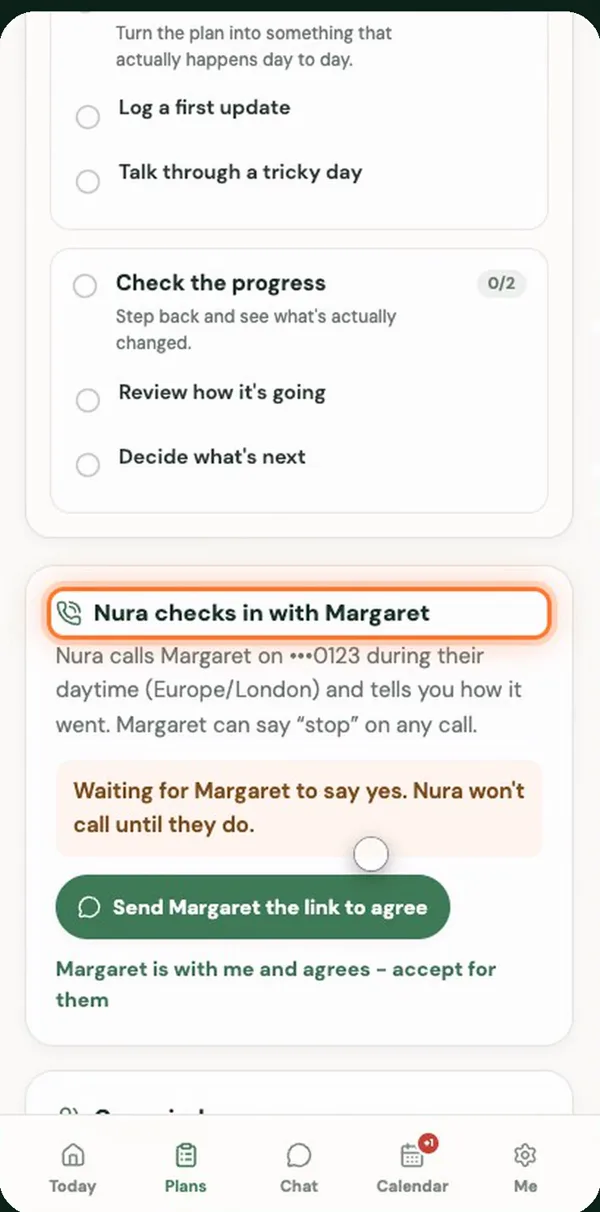
Nura can't assess anyone or arrange council support, and its Care plans aren't a council care and support plan. What it does is keep your own plan going in the meantime. You describe the situation in your own words and Nura drafts a plan with next steps and check-ins, which makes it easier to notice, and have written down, what's getting harder before an assessment. If you look after someone and they agree on a link you send, Nura gives them a short call in their daytime and tells you how it went.
Sources
General information, not medical advice. Nura does not diagnose, prescribe or replace your clinician. In an emergency call 999 (UK) or 911 (US); in the UK, NHS 111 can help if you need medical help but it isn't an emergency.