
How to write a care plan for a family member
Write it with the person, not about them. Cover what matters to them, what they can do themselves, the help they need and when, who provides each piece of help, the contacts everyone needs, what to do if something goes wrong, and when you'll look at it again. Keep it short enough that anyone stepping in can read it in five minutes.
Why is this harder than it sounds?
"Care plan" can mean a council's care and support plan, a plan a hospital writes when someone leaves, a clinical plan written by nurses, or a family's own plan. A family plan is the one nobody writes for you, yet it's what holds the week together: who's visiting Tuesday, who's doing the shopping, what Mum likes for lunch, who to call if she doesn't answer. If you're a nurse or care worker, your organisation's own format comes first; this guide is for families.
What should a care plan include?
A useful family care plan borrows from what the NHS says a council care and support plan should cover (what's important to the person, what they can still do, the care and equipment they need and how and when it happens, what family and friends think, and who to contact) and adds the practical detail families need:
- About them: what matters to them, routines they like, things they don't want.
- What they can do themselves, so help doesn't take that away.
- Daily and weekly help: meals, shopping, medicines reminders, washing, getting out, company.
- Who does what, and when: family, friends, paid carers, services.
- Contacts: GP practice, pharmacy, care agency, neighbours with keys, council social services.
- Health notes they're happy to share, such as conditions and where their medicine list is kept.
- If something goes wrong: who to call, where the key is, alarm details.
- Review date.
What is the structure of a care plan?
Most plans, family or professional, follow the same shape: the person and their goals, their needs, the actions or support for each need, who is responsible, and when it's reviewed. Writing it as a short table (need, what helps, who, when) is often clearer than paragraphs.
What should you do?
Sit down with the person
Ask what a good day looks like for them, what they find hard, and what they want help with. Write their words down.
List the needs, one per line
"Shopping", "remembering tablets", "company in the afternoons", "getting to the club on Thursdays".
Put a name and a time next to each
Gaps become obvious when a line has no name next to it.
Add the contacts and the emergency plan
Who has a key, the alarm details, and who to call first if they don't answer.
Share it
Everyone who helps should see the same version. Keep it somewhere easy to update.
Set a review date
Every few months, and after any fall, illness or hospital stay.
What tends not to work
Writing it about someone without asking them.
A long document nobody reads. Short and current beats complete and out of date.
Treating a family plan as a substitute for a council needs assessment if more help is needed.
Common questions
How do you write a care plan for an elderly parent?
Start with what matters to them, list what they need help with, put a name and a time against each item, add contacts and an emergency plan, share it, and review it every few months.
Is a family care plan the same as a council care plan?
No. A council care and support plan follows a needs or carer's assessment and sets out the support the council arranges. A family plan covers everything else.
Where Nura fits
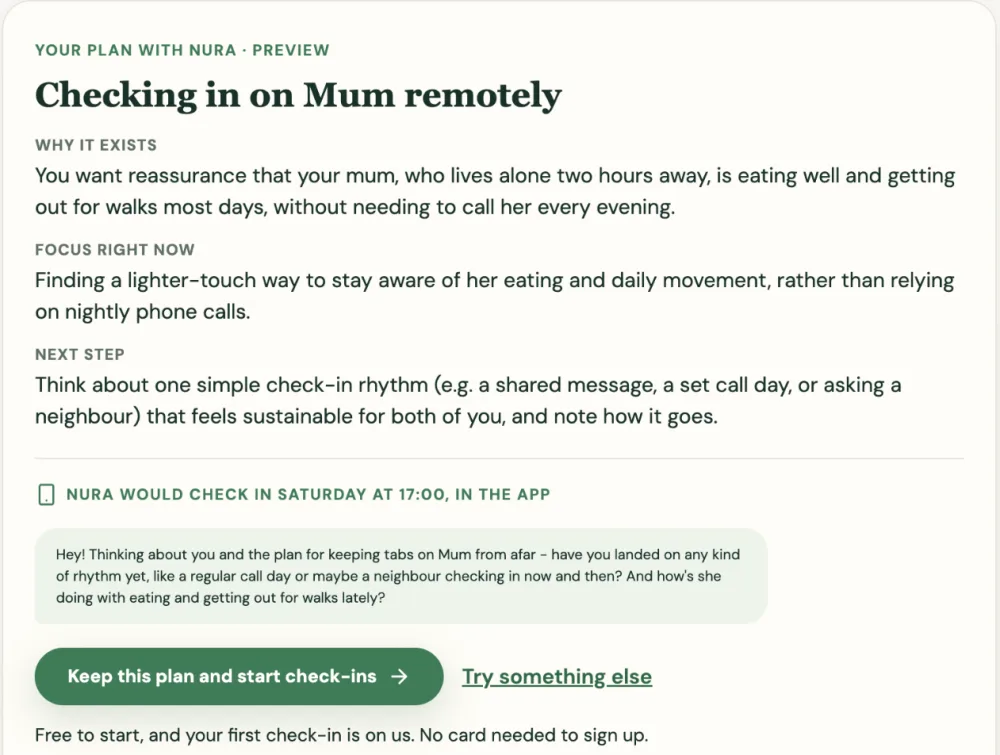
Nura's Care plans are a simple place to keep a family plan going. You describe the situation in your own words and Nura drafts a plan with next steps and check-ins; you can change it as things move on, and invite siblings or a friend to see the same plan (never your private conversation with Nura). If the plan is about someone else and they agree, Nura can give them a short call in their daytime and tell you how it went. It isn't a council care and support plan or a clinical care plan, and it doesn't replace either.
Sources
General information, not medical advice. Nura does not diagnose, prescribe or replace your clinician. In an emergency call 999 (UK) or 911 (US); in the UK, NHS 111 can help if you need medical help but it isn't an emergency.