
What is a carer's assessment, and how do you prepare?
A carer's assessment is a free conversation with your local council (or an organisation it works with) about how caring affects you: your physical and mental health, work, free time and relationships. Anyone over 18 who cares for someone can ask for one. It can lead to support such as breaks, help with housework, transport costs or support groups, and if you qualify the council writes a care and support plan with you.
Why is this harder than it sounds?
Many carers never ask, because they don't see themselves as carers or think the help is only for the person they look after. Others go in, say "I'm fine, I manage", and come away with nothing. The assessment is about you, and it only works if you describe honestly what a normal week is like.
What can a carer's assessment recommend?
The NHS gives examples such as:
- Someone to take over caring so you can take a break.
- Gym membership or exercise classes to relieve stress.
- Help with taxi fares if you don't drive.
- Help with gardening and housework.
- Training in how to lift safely.
- Putting you in touch with local support groups.
- Advice about benefits for carers.
What happens at the assessment?
Someone asks how you're coping with caring, including your health, work, free time and relationships. It's usually face to face, though some councils do it by phone or online, and the NHS says it usually lasts at least an hour. You can have the person you care for, a friend or relative with you, or an advocate.
The NHS suggests having ready your NHS number, your GP's details, contact details for anyone coming with you, and the name, address, date of birth and NHS number of the person you care for if you have them.
What should you do?
Ask for it
Contact adult social services at your local council (for a child, the children with disabilities department). You can call or apply online.
Ask for both assessments together
If the person you care for hasn't had a needs assessment, you can ask for both at the same time.
Keep a week's diary first
Write down everything you do, including nights, emotional support, paperwork and travel. The NHS says to give as much detail as you can about the impact on your life.
Say what you'd want
A regular break, help with a specific task, time to work or study. Be concrete.
Follow up the result
If you qualify, you'll get a care and support plan. If not, the council should still give free advice about help in your community. You can complain if you disagree.
What tends not to work
Playing it down because you feel you should cope.
Only describing the physical tasks and leaving out the worry, broken sleep and lost time.
Assuming you don't count as a carer because you're family.
Common questions
Who can have a carer's assessment?
Anyone over 18 who cares for someone. The NHS says you're a carer if you regularly look after someone because they're ill, older or disabled, including family members.
Does a carer's assessment affect the person I care for?
It's separate from their needs assessment, though you can have them at the same time.
Is a carer's assessment free?
Yes. Any support it leads to may involve a financial assessment.
Where Nura fits
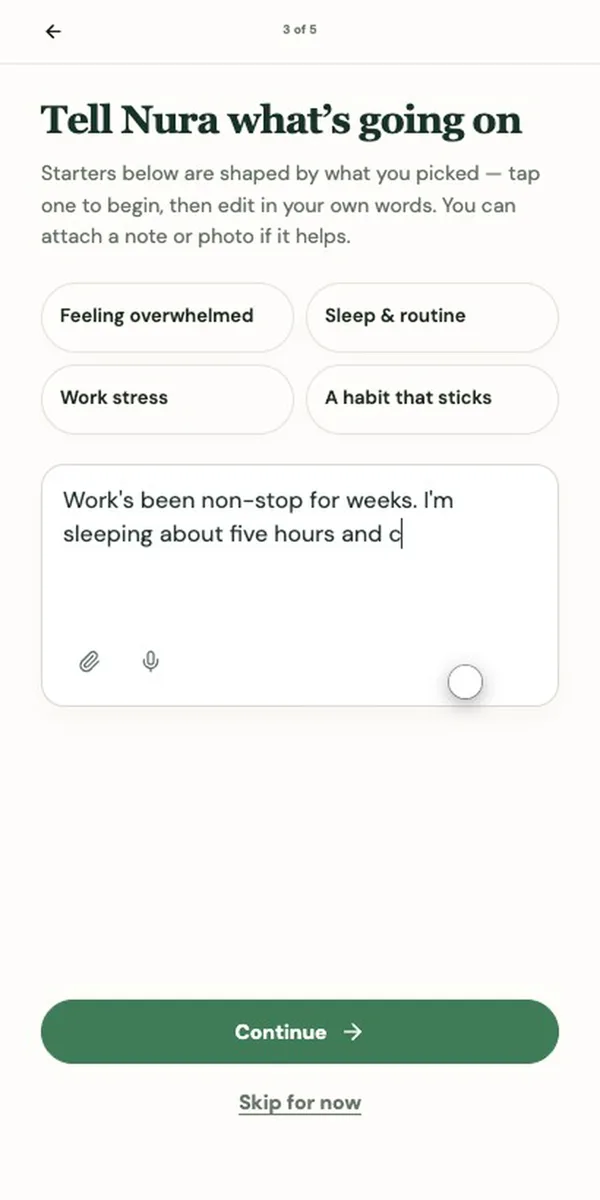
A short log makes an assessment much easier, and Nura can help you keep one. You can tell Nura how things went in a sentence or a voice note, and it keeps your notes in a Care plan. If the person you care for agrees, Nura can also give them a short call in their daytime and send you a summary of each call, which shows how things have actually been going between visits.
Sources
General information, not medical advice. Nura does not diagnose, prescribe or replace your clinician. In an emergency call 999 (UK) or 911 (US); in the UK, NHS 111 can help if you need medical help but it isn't an emergency.