
What are care plans? The main types explained
A care plan is a written plan setting out someone's needs and the support that meets them. The main types are: the council's care and support plan (after a needs assessment), a carer's support plan (after a carer's assessment), the plan a hospital makes when someone needs more care after leaving, personalised care plans that health professionals agree with people who have long-term conditions, and the informal plans families keep themselves.
Why is this harder than it sounds?
People hear "care plan" from social workers, nurses, hospitals and care homes and assume it's all one document. It isn't, and the differences matter: they're written by different people, for different reasons, and you ask for reviews or changes in different places. Knowing which one you're dealing with tells you who to call.
What is a care plan in health and social care?
The main kinds:
- Care and support plan (social care): written by the local council after a needs assessment if support is needed. Covers the care, equipment, personal budget and who to contact. Usually reviewed within the first few months, then yearly.
- Carer's support plan: written after a carer's assessment if the carer qualifies, for example covering breaks and practical help.
- Hospital discharge plan: when someone is leaving hospital and needs more care, the NHS says a plan is made covering things like support at home.
- Personalised care plan: agreed between a person and their health professionals, often for a long-term condition.
- Care home care plan: each resident's plan for their daily care, written by the home.
- Family care plan: informal, written by the family, covering routines, who does what and emergencies.
Who can see or change a care plan?
The person the plan is about should be involved and get a copy of formal plans. For a council plan, ask adult social services for a review at any time if things change. For a hospital or health plan, ask the team that wrote it. If explaining things is hard, the NHS notes an advocate can speak up for you and is often free.
What should you do?
Work out which plan you have
Look at who wrote it: the council, a hospital, a GP or specialist team, a care home, or your family.
Get a copy
You, or the person it's about, should have one for any formal plan.
Check it against real life
Is the support in the plan actually happening?
Know who to ask for changes
Council plans: adult social services. Health plans: the team that wrote them.
Keep a family plan for the gaps
Formal plans rarely cover who calls, who visits and what to do if no one can reach someone.
What tends not to work
Assuming one plan covers everything.
Not asking for a copy.
Waiting for a scheduled review when something has clearly changed.
Common questions
What is the purpose of a care plan?
To set out someone's needs and the support that meets them, so everyone involved knows what's meant to happen and it can be checked and reviewed.
Is a care plan a legal document?
A council care and support plan is part of the council's formal process, and you can complain if you disagree with it. Family plans are informal.
Where Nura fits
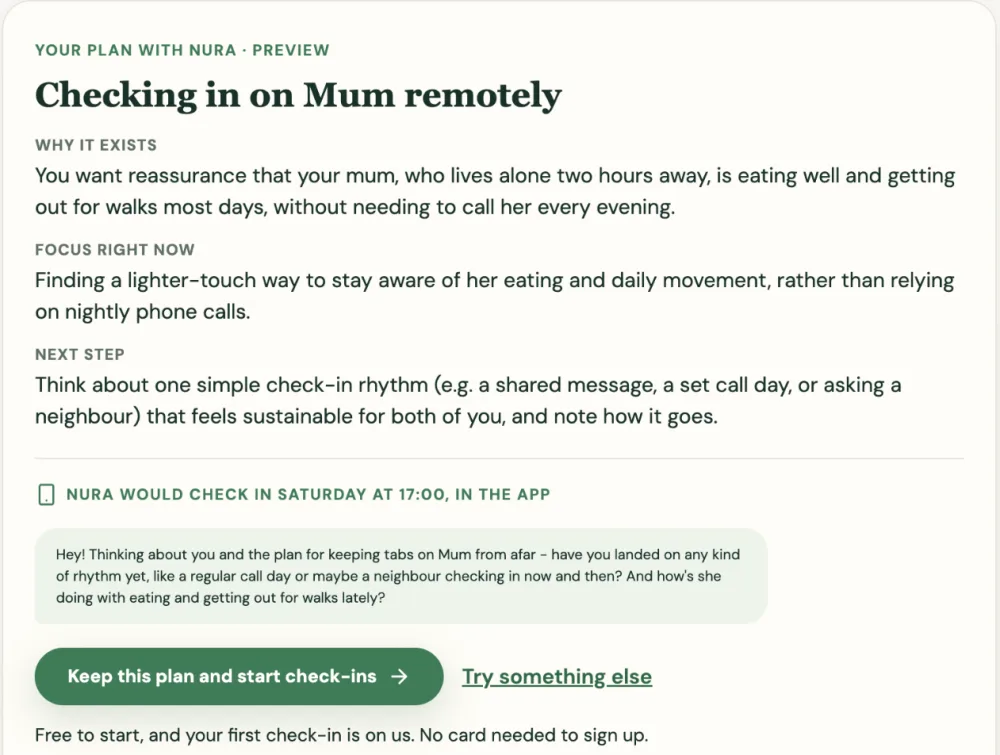
In Nura, a "Care plan" is your own plan inside the app, about you or someone you look out for. It holds notes and next steps and comes with check-ins at times you choose, by app, WhatsApp or short call. If it's about someone else and they agree, Nura can call them in their daytime and tell you how it went. It isn't a council, hospital or clinical care plan and doesn't replace one.
Sources
General information, not medical advice. Nura does not diagnose, prescribe or replace your clinician. In an emergency call 999 (UK) or 911 (US); in the UK, NHS 111 can help if you need medical help but it isn't an emergency.