
How to do a daily wellbeing check-in with yourself
Once a day, at the same time, spend two minutes rating or describing five things: sleep, mood, energy, movement and connection with other people. Note one thing that went well and one small thing you'll do tomorrow. Look back once a week for patterns, such as what your best days have in common.
Why is this harder than it sounds?
Most of how we feel day to day is shaped by ordinary things (sleep, stress, food, movement, people), but they're easy to lose track of. A quick daily check-in turns a vague "I've been rubbish lately" into something you can act on. The hard part is keeping it going after the first enthusiastic week.
The five-question daily check-in
- Sleep: how did I sleep, roughly how long?
- Mood: in a word, how am I feeling?
- Energy: low, OK or good?
- Movement: did I get out or move today?
- Connection: who did I talk to properly?
- Plus: one thing that went well, and one small thing for tomorrow.
Why these five?
The NHS's 5 steps to mental wellbeing include connecting with other people and being physically active, and its sleep guidance links poor sleep with feeling tired, irritable and less able to cope. Tracking these together helps you see which one moves the others.
What should you do?
Attach it to something you already do
After brushing your teeth, on the bus home, with your evening tea.
Keep it to two minutes
One word per question is enough.
Write it somewhere you'll see again
A notes app, a notebook, or a check-in app that keeps the history.
Review weekly
What did good days have in common? What drained you?
Change one thing at a time
An earlier wind-down, a lunchtime walk, a call to a friend. Then watch the check-ins.
What tends not to work
Long journaling sessions you'll abandon.
Judging yourself for low days. The point is noticing.
Tracking everything and changing nothing.
Common questions
What is a wellbeing check-in?
A short, regular moment to notice how you're doing, usually covering sleep, mood, energy, activity and connection.
Morning or evening check-in?
Whichever you'll keep. Evening is good for reflecting on the day; morning is good for sleep and setting one intention.
Where Nura fits
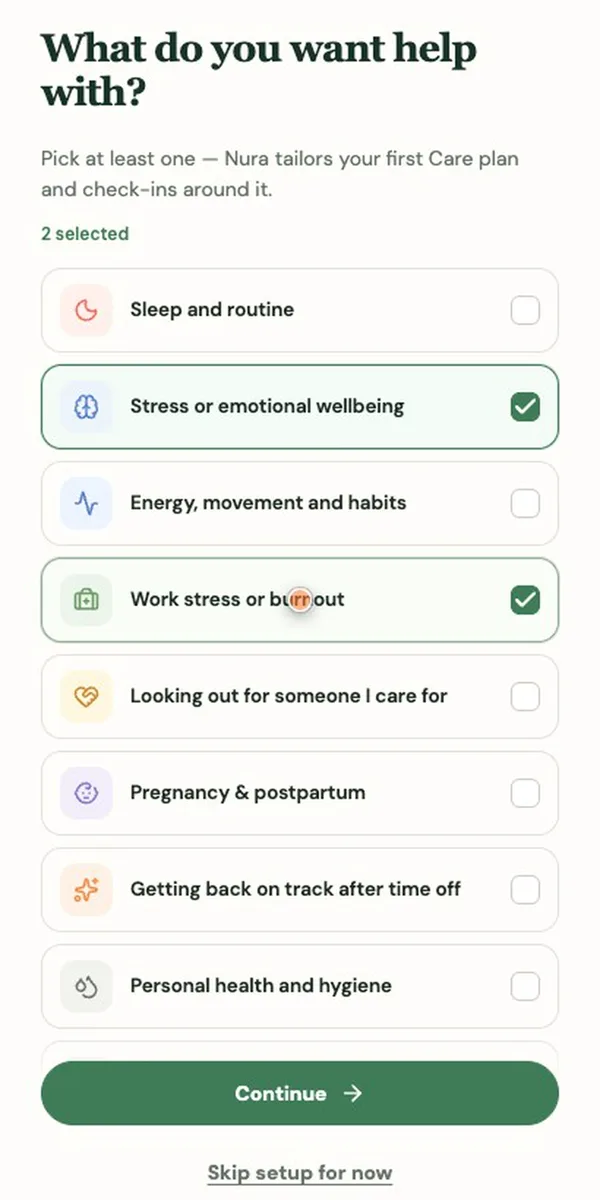
Nura can run the check-in for you instead of relying on memory. It asks at the time you choose, in the app, on WhatsApp or with a short call, keeps what you say in a Care plan, and follows up on the small step you picked. If you connect Apple Health or Health Connect, it can read daily sleep and steps (only the types you allow). If you mention thoughts of self-harm or immediate danger, it tells you to contact emergency or crisis services straight away.
Sources
General information, not medical advice. Nura does not diagnose, prescribe or replace your clinician. In an emergency call 999 (UK) or 911 (US); in the UK, NHS 111 can help if you need medical help but it isn't an emergency.