
How to fix your sleep schedule
Pick a wake-up time you can keep every day, including weekends, and stick to it even after a bad night. Go to bed only when you're sleepy, give yourself an hour to wind down, keep screens out of the last part of the evening, and avoid caffeine and alcohol late in the day. Your bedtime will settle earlier within a week or two because your body clock follows a fixed wake time.
Why is this harder than it sounds?
Most people try to fix a late schedule by going to bed early, then lie awake, get frustrated, and sleep in to make up for it, which pushes everything later again. The NHS advice for poor sleep focuses on the opposite end: getting up at the same time every day and not sleeping in after a bad night. Late-night phones, irregular shifts and stress make the drift worse.
What the NHS suggests for better sleep
For people who regularly struggle to sleep, the NHS suggests:
- Only going to bed when you're sleepy.
- Waking up and getting out of bed at the same time every day.
- Relaxing for at least an hour before bed, for example a bath or a book.
- Keeping the bedroom dark and quiet, and the bed comfortable.
- Exercising regularly during the day, but not in the 4 hours before bed.
- Avoiding caffeine, alcohol and smoking in the 6 hours before bed, and big meals late at night.
- Not using phones or watching TV right before bed.
- Not napping during the day, and not sleeping in after a bad night.
How long does it take to fix a sleep schedule?
It varies. Moving a fixed wake time earlier by 15 to 30 minutes every few days is gentler than a big jump. The NHS says most healthy adults need around 7 to 9 hours, and that if changing your sleep habits hasn't helped, or you've had trouble sleeping for months, it's worth seeing a GP.
What should you do?
Choose your wake-up time
Make it one you can keep seven days a week. This is the anchor.
Get light early
Open the curtains or get outside soon after waking. It helps your body clock know it's morning.
Move bedtime gradually
Go to bed when you're sleepy, not at a target time. As the fixed wake time takes effect, sleepiness arrives earlier.
Build an hour of wind-down
Same few steps each night: dim lights, phone on charge outside the bedroom, something calm.
Cut late caffeine and alcohol
The NHS suggests none in the 6 hours before bed.
Don't sleep in after a bad night
It's tempting, but it resets the clock you're trying to fix.
What tends not to work
Going to bed hours early and lying awake.
Catching up with long weekend lie-ins.
Scrolling in bed "until you feel tired".
Daytime naps while you're resetting.
Common questions
Can I fix my sleep schedule in one night?
Usually not. Staying up all night to reset tends to backfire. A fixed wake time kept for a week or two works better.
Should I nap if I'm tired while fixing my sleep?
The NHS advice for poor sleep is not to nap during the day.
How many hours of sleep do adults need?
The NHS says most healthy adults need around 7 to 9 hours a night, though it varies.
Where Nura fits
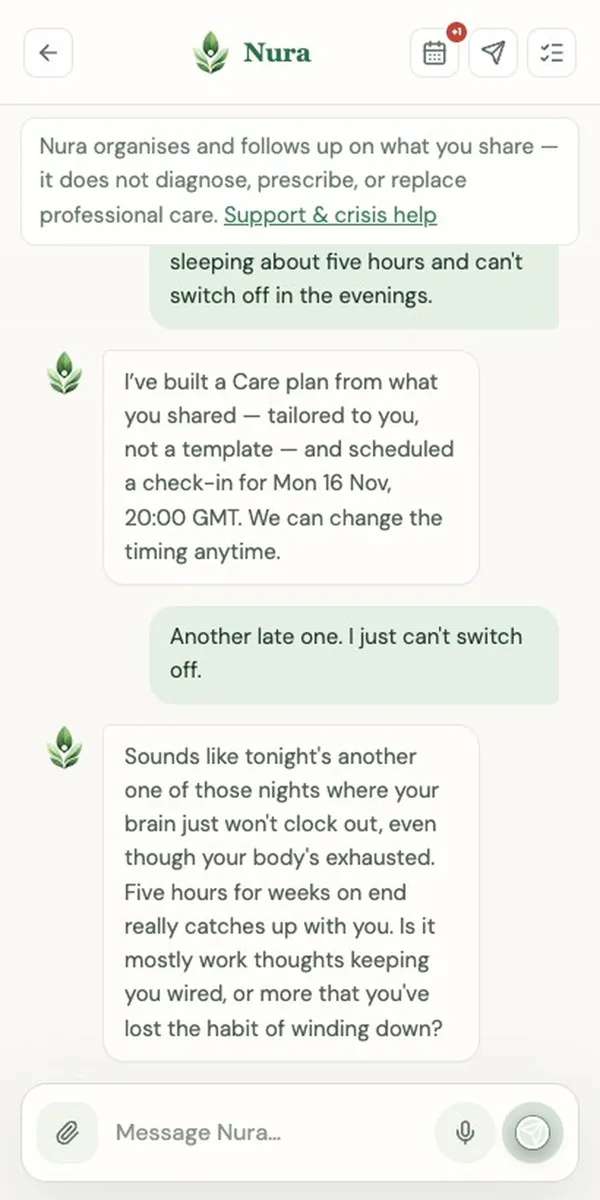
Nura can be the nudge that keeps a new schedule going. Tell it your target wake time and what's been keeping you up, and it checks in at a time you choose, in the app, on WhatsApp or with a short call, asking how last night went and keeping a note so you can see the trend. If you connect Apple Health or Health Connect, it can read a daily sleep summary (only the types you allow). It doesn't diagnose sleep problems; if poor sleep keeps going, talk to your GP.
Sources
General information, not medical advice. Nura does not diagnose, prescribe or replace your clinician. In an emergency call 999 (UK) or 911 (US); in the UK, NHS 111 can help if you need medical help but it isn't an emergency.