
How to stay consistent with healthy habits
Make the habit small enough to do on your worst day, tie it to a fixed cue (a time or something you already do), plan in advance what you'll do on bad days, and have something check in with you regularly. Consistency comes from making it easy to restart after a miss, not from never missing.
Why is this harder than it sounds?
Most habits fail in the second or third week, when the novelty wears off and normal life (a late shift, a cold, a stressful week) gets in the way. One missed day turns into "I've blown it", and the habit quietly stops. All-or-nothing goals make this worse.
What makes habits stick?
- A tiny version: "walk for 10 minutes" survives bad weeks better than "run 5k".
- A fixed cue: "after I make my morning coffee", not "sometime today".
- A plan for bad days: decide now what the minimum is when you're tired or ill.
- A quick restart rule: never miss twice.
- Something that checks in: a friend, a group or a reminder that asks rather than just announces.
- Seeing progress: a simple record you can look back on.
Which habits are worth starting with?
Ones that support everything else. The NHS's 5 steps to mental wellbeing include connecting with people and being physically active, and its physical activity guidelines suggest adults are active every day in some way. A regular sleep time is another foundation habit.
What should you do?
Pick one habit
Just one. Write it as a specific action with a time or cue.
Shrink it
Cut it down until it feels almost too easy.
Decide your bad-day version
Two minutes, one glass of water, one stretch. It still counts.
Get a check-in
Ask a friend, join a group, or use something that asks you whether you did it.
Review after two weeks
Keep it, grow it slightly, or change the cue if it isn't working.
What tends not to work
Starting five habits at once.
Big goals with no bad-day version.
Reminders you've learnt to swipe away.
Common questions
How long does it take to form a habit?
It varies a lot between people and habits. Focus on making the habit easy to repeat rather than counting days.
What should I do when I miss a day?
Do the smallest version the next day. Missing once is normal; missing twice is when habits slip.
Where Nura fits
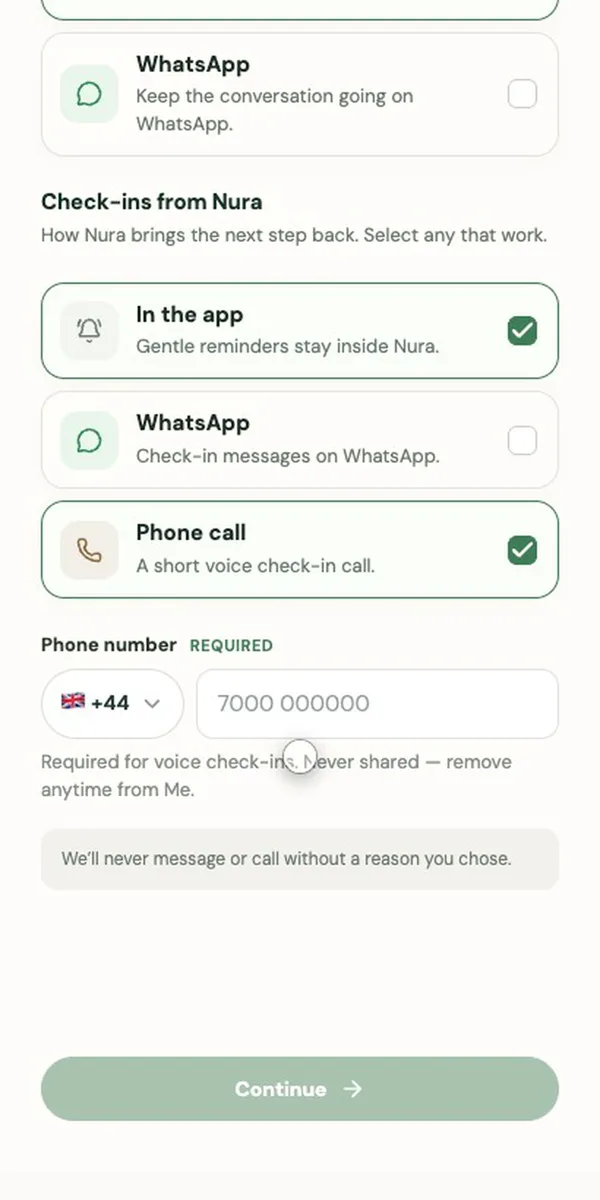
Nura is built for this. Tell it the habit and when, including routine times like "after work" (it asks once what that means for you and remembers), and it checks in daily, on weekdays or weekly, in the app, on WhatsApp or with a short call. It asks how it went rather than just pinging you, and if you're having a hard week it shrinks the step instead of piling on.
Sources
General information, not medical advice. Nura does not diagnose, prescribe or replace your clinician. In an emergency call 999 (UK) or 911 (US); in the UK, NHS 111 can help if you need medical help but it isn't an emergency.