
How to stay in touch with a parent who lives alone after Christmas
Agree a rhythm before you leave: fixed days and a time for calls, a small daily touchpoint such as a photo or a message, and the next visit already in the diary. Share the calls with brothers, sisters and grandchildren so it doesn't rest on one person, and keep each call about them and their day, not a list of questions.
Why is this harder than it sounds?
The house goes from full to silent in a day. Cards come down, the weather is poor, clubs and groups often pause until mid-January, and your own life fills up again with work and school. Good intentions made on Boxing Day rarely survive without a plan. The NHS says older people are particularly at risk of loneliness if they live alone or don't have regular contact with others, and the weeks after Christmas are when regular contact is easiest to let slip.
A simple rhythm for January
Change the days to suit your family. What matters is that your parent knows when to expect you.
- Two fixed calls a week, same days, same time. Short is fine.
- One small thing most days: a photo, a voice message, a question about the crossword or the football.
- A longer catch-up at the weekend, on video if they like it.
- A different family member each week for an extra call, so they hear more than one voice.
- The next visit, or their visit to you, written on their calendar.
What to talk about so it doesn't feel like checking up
Ask about something specific from last time: the neighbour's dog, the programme they were watching, what they cooked. Tell them something small about your own day, so the call goes both ways.
The NHS suggests older people who feel lonely keep in touch by phone or video call, join local groups or classes, invite someone round even for a short visit, and plan things to look forward to. You can help with each of those from a distance: look up when their group starts again, or plan something for February together.
If they seem low
A flat week in January is common. The NHS suggests seeing a GP if someone is struggling to cope with low mood, or has had a low mood for more than 2 weeks. If they need help urgently and it isn't an emergency, call NHS 111. For someone who is struggling and wants to talk, Samaritans are on 116 123. In an emergency, call 999.
What should you do?
Agree the rhythm before you leave
Ask what they'd like: mornings or evenings, calls or messages, how often. Write the days on their calendar as well as yours.
Put it in your own diary as a repeat
A repeating reminder on your phone turns a promise into a habit. Treat it like any other appointment.
Share it out
Give brothers, sisters and older grandchildren a day each. Three people ringing once a week is steadier than one person trying to ring daily.
Add a small daily touchpoint
A photo of the dog, the view from the train, what's for tea. It takes seconds and tells them they're in your day.
Plan one thing to look forward to
A visit, a lunch out, a trip to see the grandchildren in a play. Having a date matters more than how big it is.
Review it at the end of January
Ask what they've liked and what felt like too much. Adjust rather than quietly dropping it.
What tends not to work
Promising a daily call you can't keep. Fewer calls that always happen are better.
Calling only when you're worried, so every call starts with "is everything all right?"
Relying on a family group chat your parent doesn't read.
Leaving it all to whoever lives nearest.
Common questions
How often should I call a parent who lives alone?
Agree it with them. A rhythm they can count on, even two short calls a week at the same time, usually helps more than long calls now and then.
What if my parent says they're fine and doesn't want a fuss?
Take them at their word and keep it light. Frame calls as something you enjoy, not something they need, and let them choose the days.
What if they don't answer when I call?
Agree in advance what happens: you try again in an hour, then ring a neighbour or friend who has agreed to knock. If you think they may be in danger, call 999.
Where Nura fits
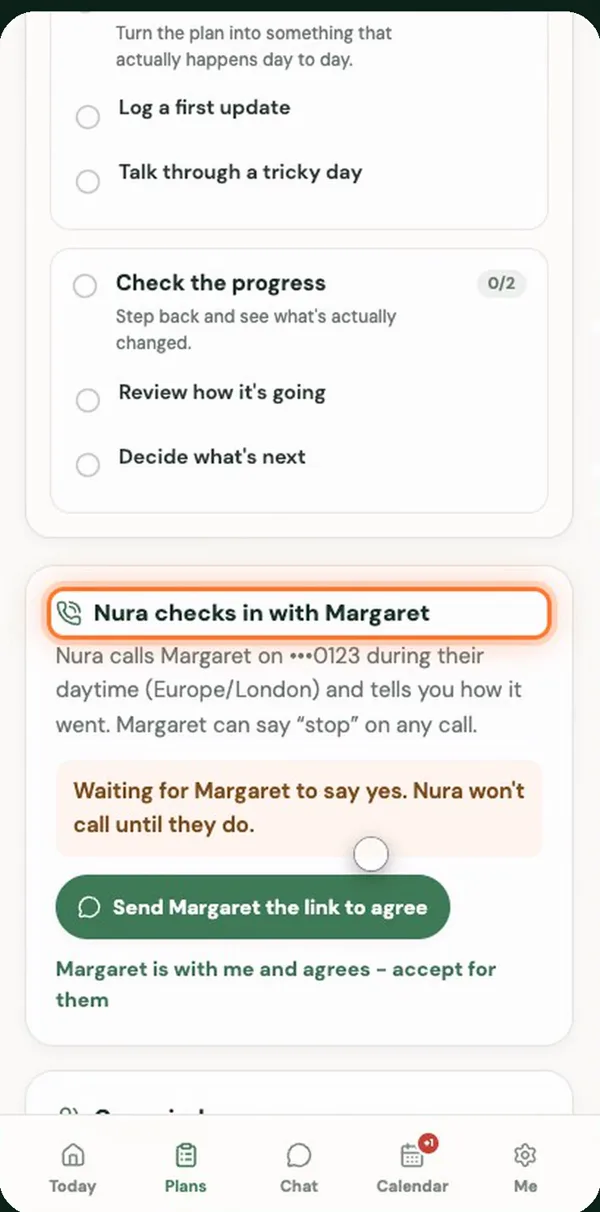
Nura can be one of the regular calls. You start a Care plan about your parent with their first name and number; once they tap Yes on a link you send (or you confirm they've agreed), Nura gives them a short, friendly call on their ordinary phone, only between 9am and 8pm their time, and asks how things are going. You get a short summary of each call, so you know what to pick up on when you ring. You can invite brothers and sisters to the same Care plan. Your parent doesn't need an app or a smartphone and can say "stop" on any call. Nura adds to the family's calls and doesn't replace them, and it isn't an alarm or an emergency service. Calls to someone you care for are part of Nura Plus. Nura Plus is US$9.99 a month after a 14-day free trial (prices may vary by region); you add a card to start the trial and can cancel before it ends.
Sources
General information, not medical advice. Nura does not diagnose, prescribe or replace your clinician. In an emergency call 999 (UK) or 911 (US); in the UK, NHS 111 can help if you need medical help but it isn't an emergency.