
How to make a medicine schedule (with a free printable chart)
List each medicine with the dose and times exactly as the label or your pharmacist says, group them by time of day (morning, midday, evening, bedtime), then make a weekly chart with a tick box for each one. Nura's free medicine schedule maker does this in your browser and prints an A4 or US Letter chart. It's a personal reminder chart, not medical advice.
Why is this harder than it sounds?
With several medicines, labels like "three times a day" or "every 8 hours" are easy to mix up, and it's hard to remember whether you've already taken something. A chart by the kettle or the pill box makes it visible, and is easy for a carer or relative to follow too. The NHS stresses giving medicines at the right time of day and knowing whether they're taken with food or between meals.
What goes on a medicine schedule?
- Medicine name and strength, as on the label.
- Dose (for example "1 tablet").
- Times of day, and whether with food or between meals if the label says.
- Days, if it isn't daily.
- A tick box for each dose.
- Pharmacy phone number at the bottom.
How do you space out "three times a day" or "every 8 hours"?
Follow the label and the leaflet, and ask your pharmacist if it isn't clear. Some medicines need precise spacing and others just need taking with meals, so it's a question for them, not a calculator. Once you know the times, put them on the chart.
What should you do?
Gather the labels
Or your repeat prescription list. Include anything you buy over the counter, and check with the pharmacist that it's safe with your prescribed medicines.
Confirm the times
Ask the pharmacist about anything unclear, such as spacing or food.
Group by time of day
Morning, midday, evening, bedtime.
Make the chart
Use the free maker linked on this page, or a sheet of paper with a row per medicine and a column per day.
Put it where the medicines are
Tick each dose as it's taken.
Redo it when anything changes
Throw the old chart away so there's only one version.
What tends not to work
Working out timings yourself when the label isn't clear.
Keeping old charts after a change.
Taking a double dose to make up for a missed one. The NHS says that's dangerous.
Common questions
Is the medicine schedule maker free?
Yes. It runs in your browser with no sign-up, and nothing you type is uploaded.
Can I use the chart for someone I care for?
Yes, with their agreement. The NHS notes the person you care for decides how much of their medicines information you see.
Where Nura fits
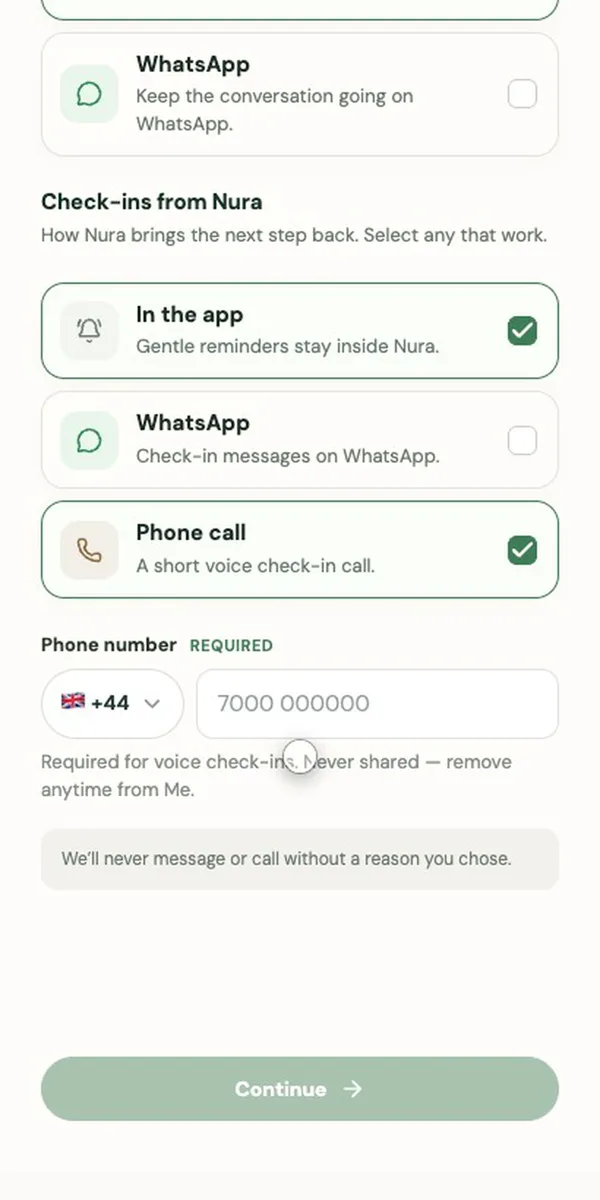
The chart shows what to take; Nura can make sure the reminder actually reaches you. Tell Nura what you want reminding about and when, and it checks in daily, on weekdays or weekly, in the app, on WhatsApp or with a short call, and asks whether it's done. Nura doesn't check doses or interactions.
Sources
General information, not medical advice. Nura does not diagnose, prescribe or replace your clinician. In an emergency call 999 (UK) or 911 (US); in the UK, NHS 111 can help if you need medical help but it isn't an emergency.