
An AI companion that checks in on you (instead of waiting for you)
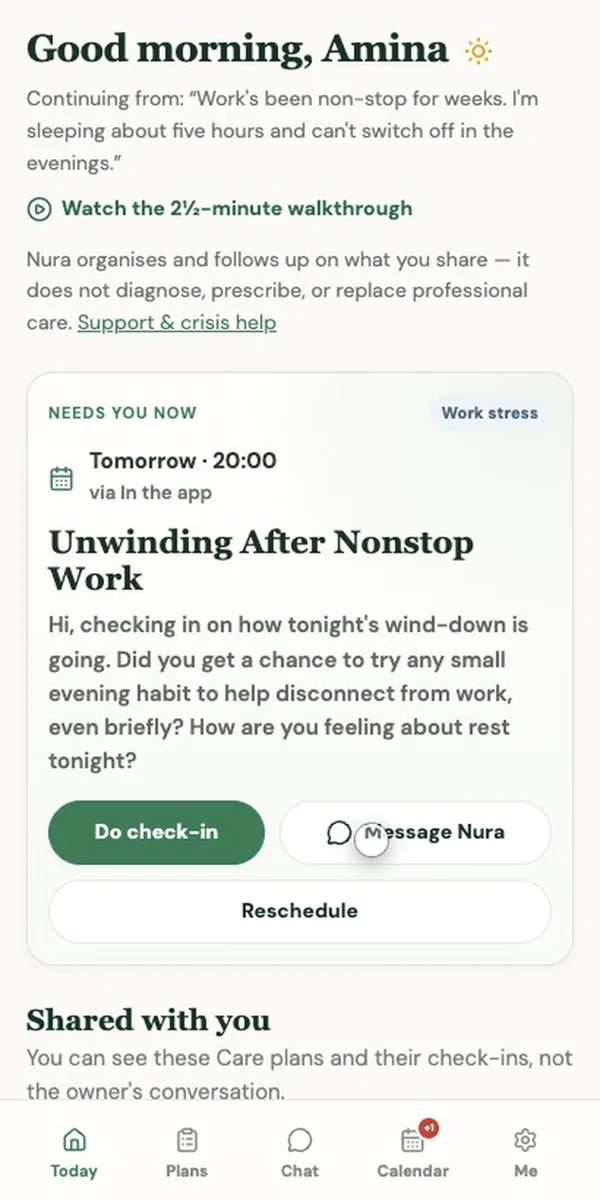
Most AI companions only talk when you open the app. A check-in companion works the other way round: you tell it what you're working on, like sleep, stress or a habit, and it comes back to you at a time you chose, by message, WhatsApp or a short call, to ask how it went and remember the answer.
Why is this harder than it sounds?
The hard part of looking after yourself isn't knowing what to do; it's remembering on an ordinary Tuesday when work runs late. Chat apps are good at answering questions, but they leave the follow-up to you, and app notifications quickly become background noise. The NHS's 5 steps to mental wellbeing are small, regular things like connecting with people, being active and taking notice, and small regular things are exactly what slip without a nudge.
What a check-in companion does differently
Compared with a chatbot you open when you remember, a check-in companion:
- Starts the conversation at a time you set, so you don't have to remember to.
- Asks about the one thing you said mattered, not a generic "how are you?".
- Remembers last time's answer, so a bad week means a smaller step, not starting over.
- Reaches you where you already are: a WhatsApp message or a short call rather than another app badge.
What it isn't
It isn't a friend replacement, a therapist or an alarm. The NHS advice on loneliness puts real-world contact first: talking to people you trust, joining groups, volunteering. A good companion nudges you toward those, not away from them.
What should you do?
Pick one thing
Sleep, stress, energy, a habit or someone you look out for. One focus works better than five.
Say it in plain words
"I'm sleeping five hours since the new job and want a wind-down that sticks." The detail is what makes the check-ins useful.
Choose when and how it reaches you
An evening WhatsApp, a short morning call, or in the app. Keep quiet hours for nights.
Answer honestly, briefly
A one-line reply is enough. "Bad night" is useful information.
Let the step shrink on hard weeks
If it isn't happening, make the step smaller rather than quitting.
What tends not to work
Setting five goals on day one.
Relying on app notifications you've learned to swipe away.
Using an AI chat in place of people you could talk to.
Expecting it to handle a crisis: it can't.
Common questions
Is there an AI that messages you first?
Yes. Some companions, Nura included, send a check-in at a time you choose instead of waiting for you to open an app. In Nura it can be an in-app check-in, a WhatsApp message or a short phone call.
Is an AI companion good for loneliness?
It can be a gentle nudge, but the NHS advice for loneliness is to build real-world contact: talking to people you trust, joining a group or volunteering. Use a companion to help you do those things, not to replace them.
Is an AI companion the same as therapy?
No. A wellbeing companion helps with routines and small steps. If you're struggling to cope, talk to your GP, or see the NHS page on urgent mental health help.
Where Nura fits
This is what Nura is built for. Tell it what's going on, and it keeps a simple Care plan and checks in at the times you choose, in the app, on WhatsApp or with a short phone call, asking how it went and remembering the answer. You can connect Apple Health or Health Connect so check-ins can notice your sleep and steps (only the types you allow). Try the planner on the home page with no account; Nura Plus is US$9.99 a month after a 14-day free trial. Nura is a wellbeing companion, not therapy or an emergency service. If you're struggling to cope or in crisis, the NHS lists where to get urgent help, and Samaritans are on 116 123 in the UK at any time (call or text 988 in the US).
Sources
General information, not medical advice. Nura does not diagnose, prescribe or replace your clinician. In an emergency call 999 (UK) or 911 (US); in the UK, NHS 111 can help if you need medical help but it isn't an emergency.