
An AI accountability partner app that texts you on WhatsApp
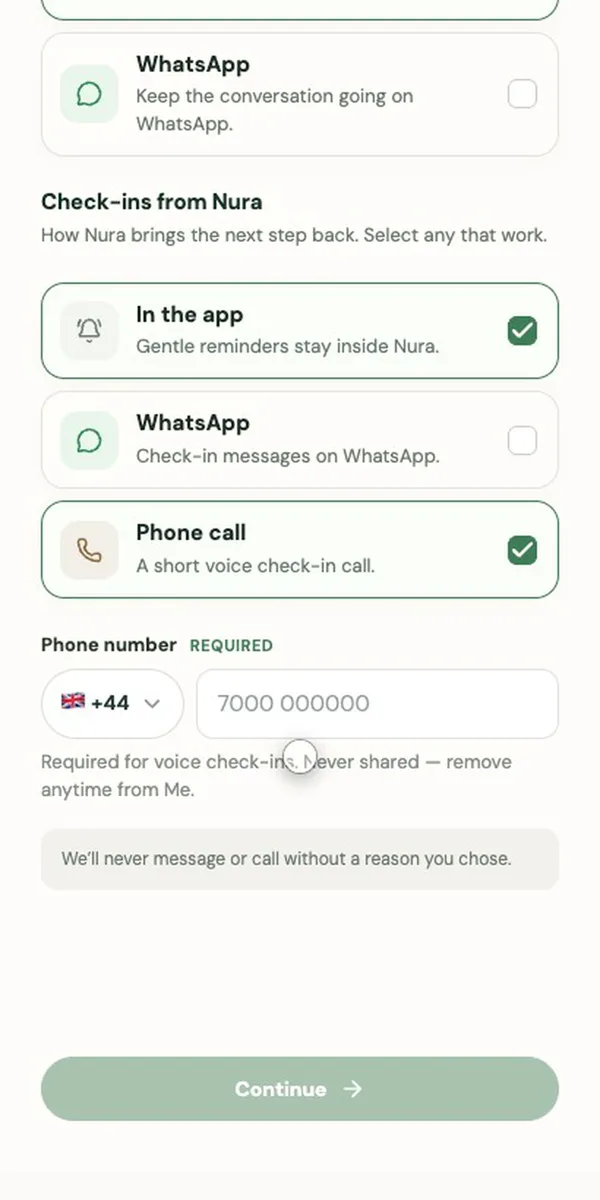
An AI accountability partner checks back on the thing you said you'd do. Tell it the habit, for example a walk after lunch or lights out by 11, and it messages you at a time you choose, on WhatsApp or by a short call, to ask how it went, then adjusts the next step to what actually happened.
Why is this harder than it sounds?
Accountability works because someone asks. Human accountability partners get busy, and reminder apps only tell you the time; they never ask how it went or notice a run of missed days. Messages in an app you rarely open are easy to ignore, while a WhatsApp message sits next to messages from real people. The NHS's advice on managing stress and building healthy routines leans on small, planned, repeatable steps, which is what a good partner keeps you to.
What to look for in an AI accountability partner
- It reaches you somewhere you already look: WhatsApp, a call, or a message you'll actually see.
- You set the times, including quiet hours.
- It asks about your specific step, not a generic mood score.
- It remembers your answers and changes the plan after a bad week.
- It's clear about what it does with what you tell it.
What should you do?
Write the habit as one small action
"10-minute walk after lunch on weekdays" beats "get fitter".
Choose the check-in moment
Just after the habit should have happened, so the question is easy to answer.
Choose the channel
WhatsApp if you live in it; a short call if messages get buried.
Reply in a few words
"Done", "skipped, meeting ran over". The reason is what helps the next plan.
Review weekly
Keep what's working, shrink what isn't, and add only one thing at a time.
What tends not to work
Tracking ten habits at once.
Punishing streak counters that make one missed day feel like failure.
Check-ins at times you're always busy.
Vague goals the partner can't ask about.
Common questions
Can an AI hold me accountable on WhatsApp?
Yes, if it can message you there. With Nura you can choose WhatsApp as a check-in channel, set the times, and reply in a few words; it remembers your answers for the next check-in.
Is an AI accountability partner better than a human one?
Not better, just more reliable about asking. A friend or group adds things an AI can't. Many people use both: the AI for the daily nudge, people for the bigger conversations.
What habits work best with check-ins?
Small, specific ones that happen at a predictable time: a wind-down routine, a short walk, drinking more water, a stress break at work.
Where Nura fits
Nura works as an accountability partner for wellbeing: sleep, stress, energy, movement and habits. You tell it the step in your own words, choose the times, and it checks in in the app, on WhatsApp or with a short call, then remembers how it went and shrinks the step on a hard week. Nura Plus is US$9.99 a month after a 14-day free trial; you can try the planner on the home page with no account. Nura is a wellbeing companion, not therapy or an emergency service. If you're struggling to cope or in crisis, the NHS lists where to get urgent help, and Samaritans are on 116 123 in the UK at any time (call or text 988 in the US).
Sources
General information, not medical advice. Nura does not diagnose, prescribe or replace your clinician. In an emergency call 999 (UK) or 911 (US); in the UK, NHS 111 can help if you need medical help but it isn't an emergency.