
How to share check-in calls for a parent between brothers and sisters
Agree a simple rota with a named person for each day or week, keep one shared place where everyone writes a line after their call, decide what happens when someone can't make it, and review the split after a month. Ask your parent first how often they'd like to be rung and by whom. It's their phone that's ringing.
Why is this harder than it sounds?
Calls usually fall to one person: the eldest, the daughter, or whoever lives nearest. Everyone else assumes it's covered. The one doing the ringing gets tired and quietly resentful, the others feel shut out or guilty, and your parent either gets three calls on Sunday and none until Thursday, or tells each of you a slightly different version of how they are. Christmas, when you're all in one place, is the easiest time of year to sort it out.
A sample rota for three siblings
An example to adapt, not a rule. Fewer calls that always happen are better than a full week that collapses by February.
- Monday evening: the eldest rings.
- Wednesday lunchtime: the second rings.
- Friday evening: the third rings.
- Sunday: whoever is free does a longer video call, with grandchildren if they're about.
- Holidays and illness: swap in the shared chat at least a day ahead, so the call still happens.
What to write down after each call
Two lines is plenty: how they sounded, and anything to follow up (a delivery that didn't come, a neighbour who's away, a date to remember). Put it where everyone can see it. The point is that the next person to ring can pick up where you left off, and nobody has to ask your parent the same questions three times.
If a call leaves you worried about their health, encourage them to speak to their GP, or call NHS 111 if it can't wait, and tell the others what you did. In an emergency, call 999.
What should you do?
Ask your parent what they'd like
How often, what time of day, and whether they'd rather have calls, messages or a mix. Some people love a daily ring; others find it too much.
Give every slot a name
"We'll all ring more" doesn't work. "You have Mondays, I have Wednesdays" does.
Split by what's realistic
Shift work, small children and time zones differ. The sibling abroad might take the weekend video call; the one nearby might swap a call for a visit.
Keep one place for notes
One shared note, chat or plan, not three separate threads. Agree that updates go there and nowhere else.
Agree what to do about a missed call
Decide who tries again, when, and who can knock on the door if nobody gets an answer. Sort this out before it happens.
Review after a month
Ask your parent how it feels and ask each other whether the split is fair. Change it before anyone reaches breaking point.
What tends not to work
Assuming the sibling who lives nearest will do all the ringing.
Keeping score of who has called most.
Everyone calling on the same day and nobody midweek.
Talking about your parent in a group they can't see, and never with them.
Common questions
How do we split calls fairly when we live in different places?
Split by what each person can do, not into equal numbers. Someone far away can take a regular video call or the paperwork; someone close can visit. What matters is that every slot has a name against it.
What if one sibling won't take a turn?
Ask for something specific and small, such as one call a fortnight, rather than "more help". If they still won't, plan around the people who will, and look at other support so the gap isn't filled by one exhausted person.
How many calls a week does a parent need?
There's no set number. Ask them. Two or three calls they can count on, spread through the week, suit many families better than a daily call that keeps being missed.
Where Nura fits
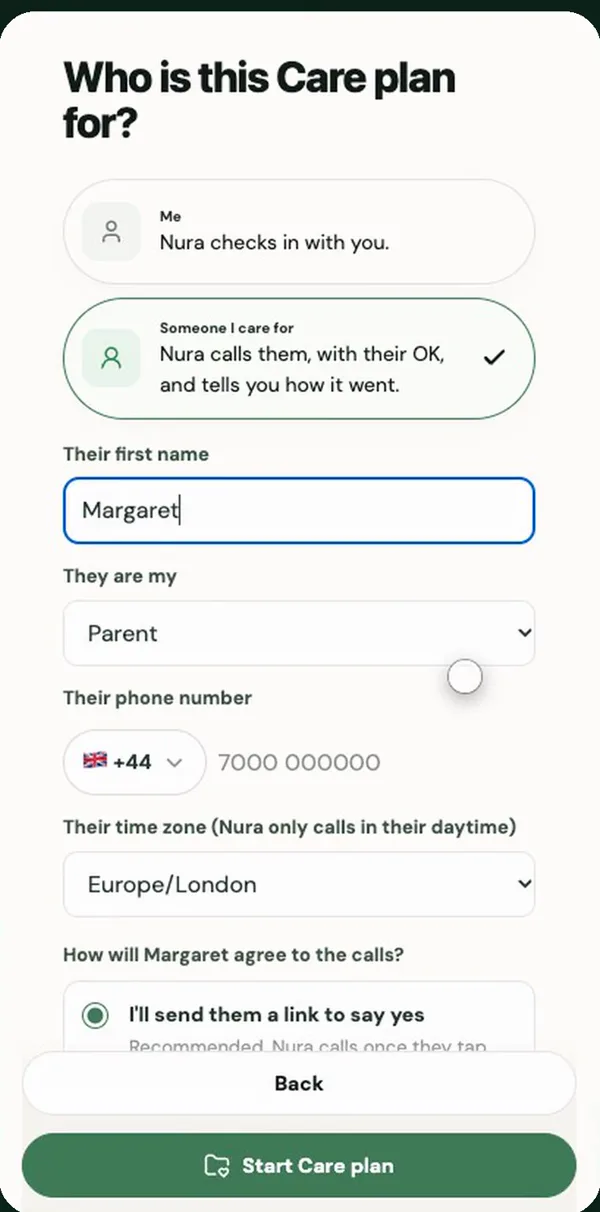
Nura can take one or more of the slots and keep everyone on the same page. One of you starts a Care plan about your parent, and once your parent agrees, Nura gives them a short call in their daytime (only between 9am and 8pm their time) and writes a short summary. You invite your brothers and sisters to that Care plan, so everyone sees the same plan, its next steps and whether check-ins are done, and Nura writes them a short update from it. You can switch on an alert that tells the people you've invited when a scheduled check-in still isn't done a day later. People you invite never see your private conversation with Nura, and your parent can say "stop" on any call. Calls to someone you care for are part of Nura Plus. Nura Plus is US$9.99 a month after a 14-day free trial (prices may vary by region); you add a card to start the trial and can cancel before it ends.
Sources
General information, not medical advice. Nura does not diagnose, prescribe or replace your clinician. In an emergency call 999 (UK) or 911 (US); in the UK, NHS 111 can help if you need medical help but it isn't an emergency.